5787 – Toldot
Parashat Toldot 5787: twins who struggle in one womb, a birthright sold for stew, wells dug again until there is room, and a blessing won by a voice alone.
Parashat Toldot 5787
Two sons struggle before they are born, one trades his birthright for a bowl of red lentils, their father digs his own father's wells again, and a blessing is given to a voice that the old man could not see.
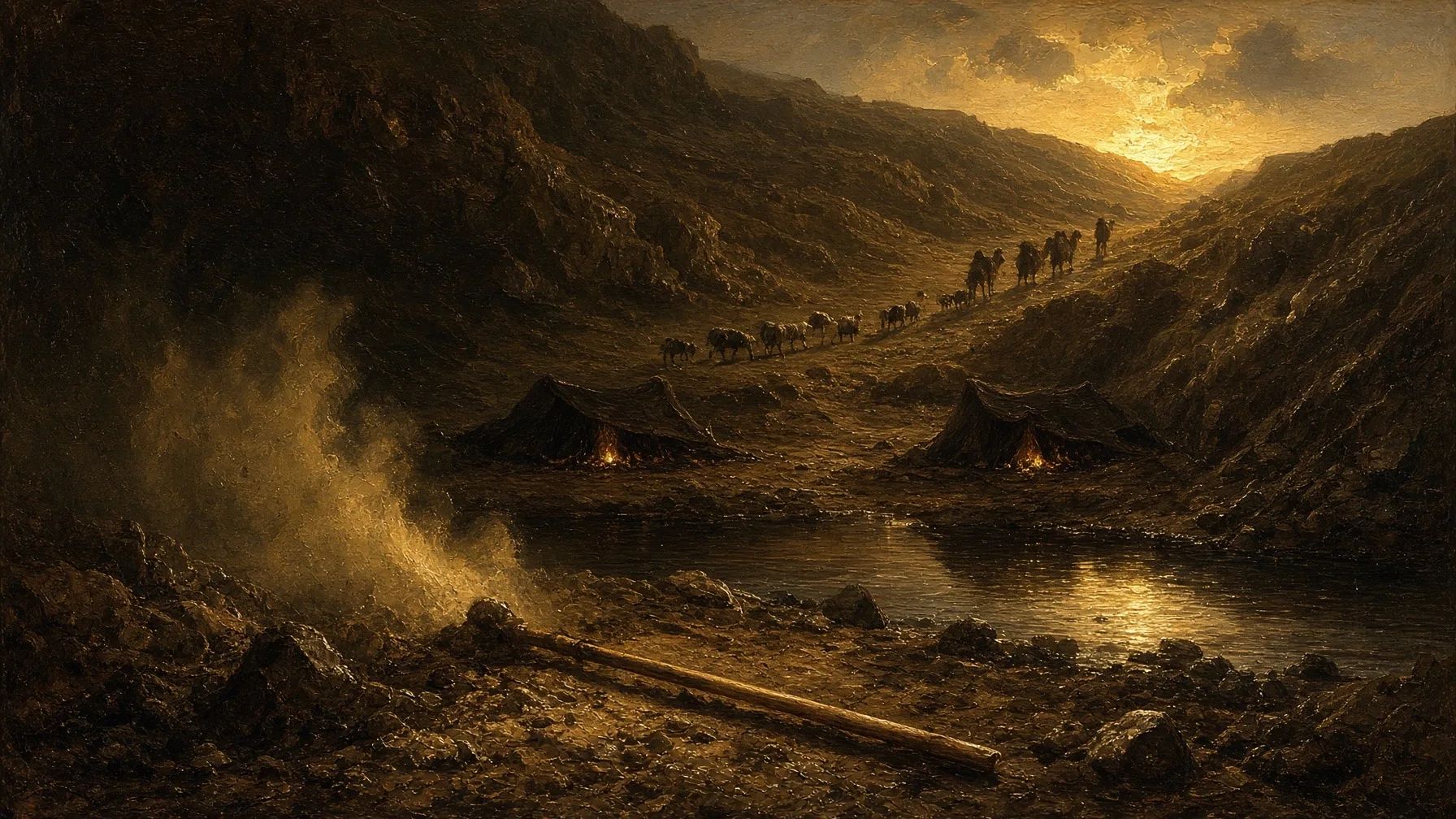
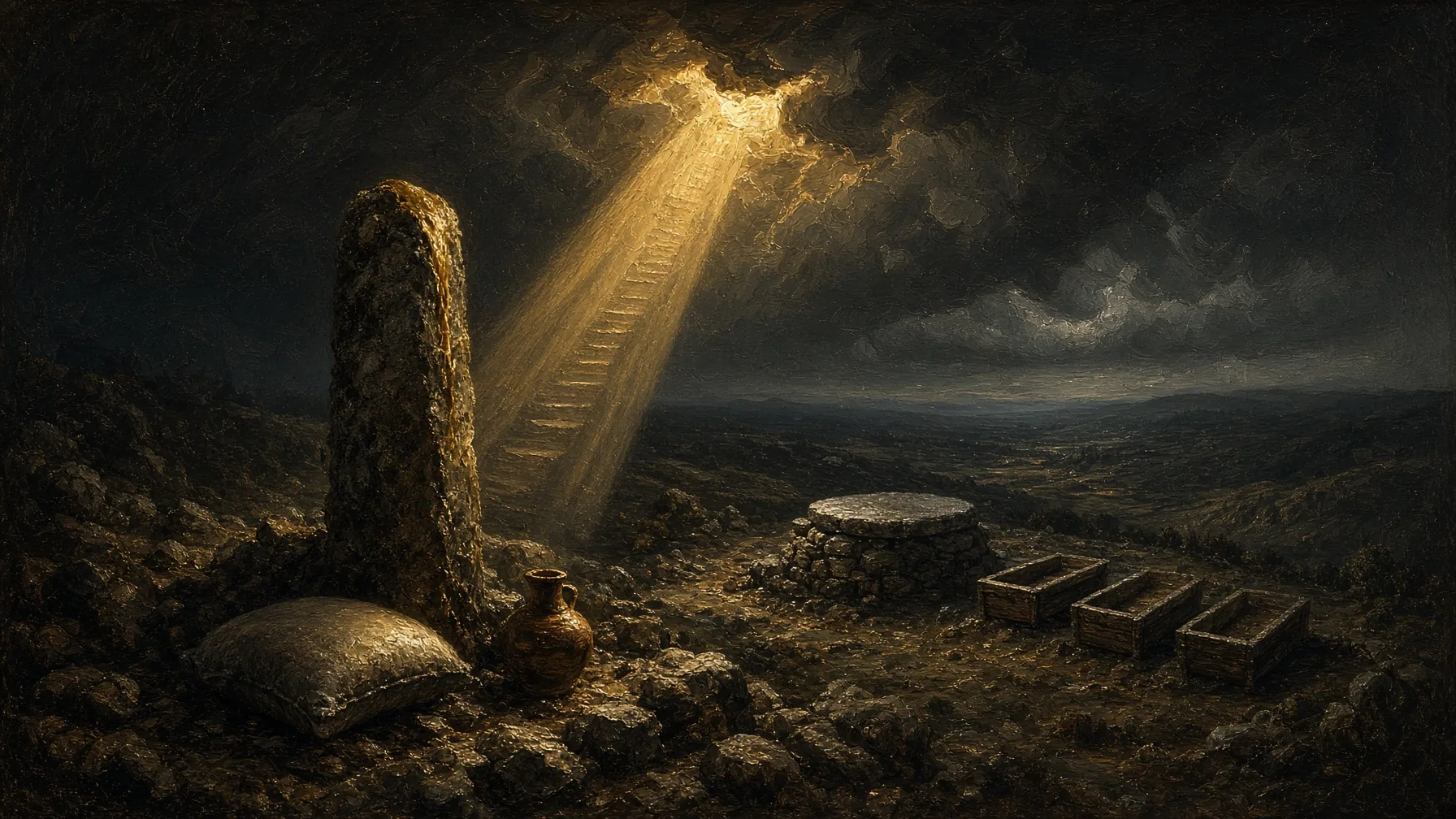
Last week Avraham was buried by his two sons together. This week the Torah turns to the generations of Yitzchak. Rivkah is barren for twenty years until Yitzchak prays opposite her, and when she conceives the children struggle inside her so hard that she goes to ask God why. She is told that two nations are in her womb, and the elder will serve the younger. Esav is born red and hairy, a man of the field; Yaakov is born holding his heel, a whole man who sits in tents. One day Esav comes in from the field exhausted, and sells his birthright for a bowl of red lentils. Famine drives Yitzchak to Gerar, where God tells him not to go down to Egypt but to stay in the land. He sows and reaps a hundredfold, the Philistines stop up Avraham's wells, and Yitzchak digs them again, quarrels over two, and calls the third Rechovot, room. Avimelech comes to make a covenant. Then the old, blind Yitzchak sends Esav to hunt for him so that he may bless him, and Rivkah dresses Yaakov in Esav's clothes. The voice is the voice of Yaakov, and the hands are the hands of Esav. Yaakov is blessed, Esav weeps and vows to kill him, and Yaakov leaves for Charan.
It is read this year in the week after President Herzog announced he would give Gadi Eisenkot the mandate to form a government, following consultations in which the two blocs each said they could not sit with parts of the other, and in which some parties could not sit with parts of their own. A portion about brothers who struggle from the womb, a trade made in hunger, wells fought over and dug again, a covenant offered by a former adversary and a blessing taken by disguise sits beside that week below. This post was written on Sunday 8 November.
Parasha at a Glance
| Name | Toldot, generations, from these are the generations of Yitzchak son of Avraham (Genesis 25:19). |
| Reading | Genesis 25:19 to 28:9, seven aliyot. Maftir Genesis 28:7 to 28:9. |
| Position | Sixth of the fifty-four parashiyot; the sixth portion of Sefer Bereshit. |
| Hebrew date | Shabbat, 4 Kislev 5787. Civil date 14 November 2026. |
| Haftarah | Malachi 1:1 to 2:7. It opens I have loved you, says the Lord, and answers the question how with is not Esav Yaakov's brother? Yet I loved Yaakov. It goes on to rebuke priests who offer the blind and the lame, and ends with the priest whose lips keep knowledge. |
| Israel this week | Sigd, the festival of Ethiopian Jewry and an Israeli national holiday, falls on Monday 9 November (29 Cheshvan). Rosh Chodesh Kislev is Tuesday 10 November (30 Cheshvan) and Wednesday 11 November (1 Kislev). V'ten tal umatar continues in Israel from 7 Cheshvan; the diaspora waits until December. |
| Central theme | Prayer that overturns a decree, two nations in one womb, the cost of trading the future for the present, staying in the land in famine, digging the old wells again until there is room, a covenant sought by a former adversary, and a blessing that goes where it was meant to go by a road that leaves a debt. |
| Next parasha | Vayetze, Shabbat 11 Kislev / 21 November 2026. |
Calendar, leyning and haftarah verified against the Hebcal Israel calendar with the diaspora setting off. This week Israel and the diaspora read the same portion and the same haftarah.
Torah Overview
The patriarch who is mostly acted upon, and the wells he would not give up.
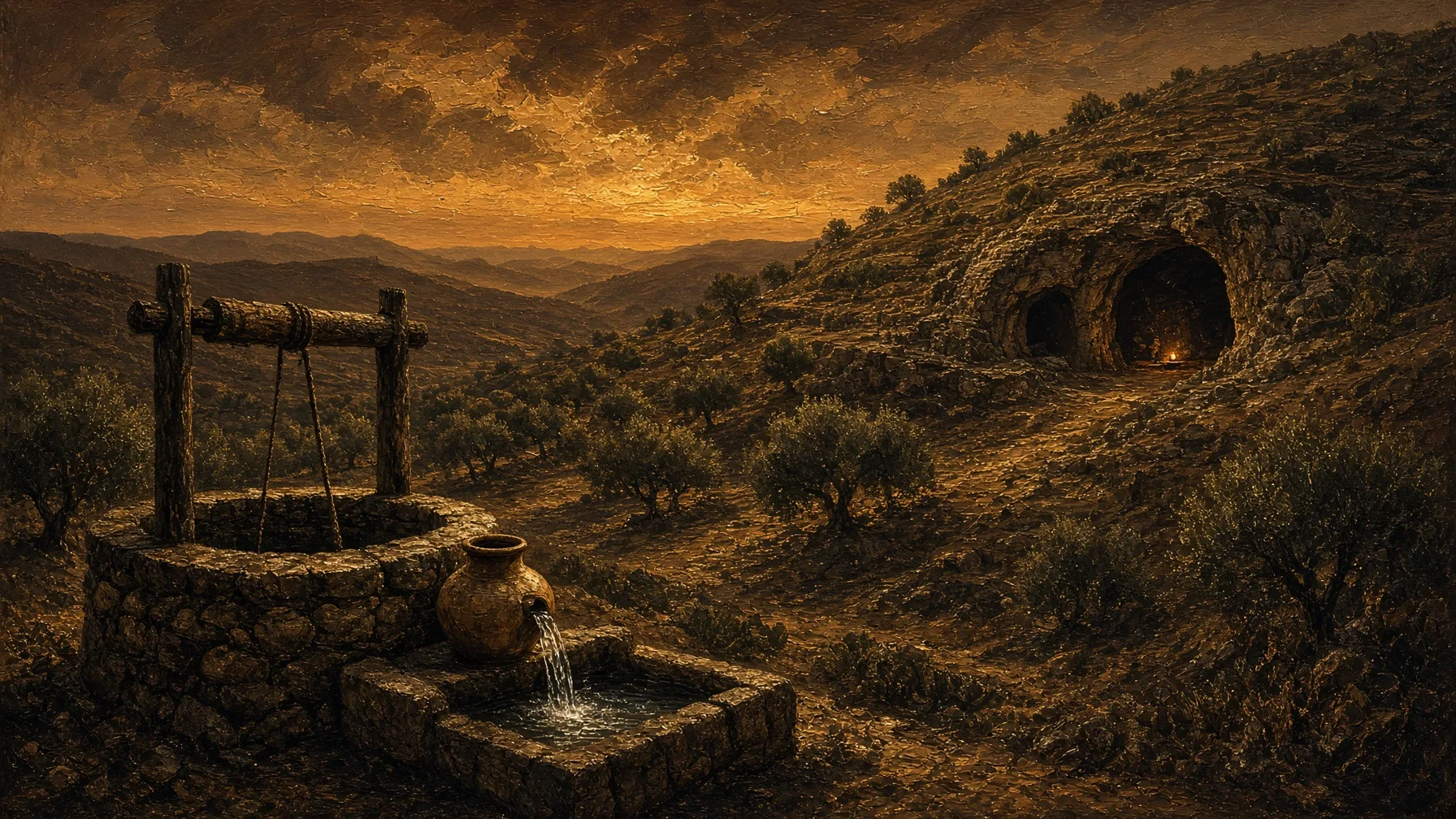
Yitzchak is the quietest of the fathers. Avraham leaves his land and argues with God over Sodom; Yaakov will flee, labour, wrestle and be renamed. Yitzchak was bound on an altar, and in his own portion he is mostly the one to whom things happen: his wife is barren, his sons struggle, the Philistines fill his wells, his younger son comes in wearing his elder son's clothes. Yet the portion is called by his name, and the few things he chooses to do are decisive. He prays opposite his wife, 25:21, and is answered. He stays in the land in a famine because he is told to, 26:1 to 3. He digs again the wells his father dug and gives them the names his father gave them, 26:18. And when he understands what has happened at the blessing, he trembles greatly and says he shall indeed be blessed, 27:33.
The birthright scene is four verses long, 25:29 to 34, and ends with the Torah's own verdict: and Esav despised the birthright. The narrator does not comment on Yaakov's price. The wells scene, 26:15 to 22, is a sequence of three: Esek, contention; Sitnah, enmity; and Rechovot, for now the Lord has made room for us, and we shall be fruitful in the land. Then at Be'er Sheva, 26:26 to 31, Avimelech comes with his adviser and his general, and says we have surely seen that the Lord was with you. They swear, and they part in peace.
The blessing in chapter 27 is told slowly and without excuse. Rivkah instructs, Yaakov objects that he will be found out and bring a curse on himself, Rivkah says upon me be your curse, my son. Yitzchak feels the goatskins and says the voice is the voice of Yaakov, and the hands are the hands of Esav. When Esav comes in, the Torah gives his cry in full: a great and exceedingly bitter cry, and have you only one blessing, my father? Esav is given a blessing of his own, by the sword, with the promise that he will one day break the yoke from his neck. He resolves to kill his brother when their father dies, 27:41 to 28:5, and Yaakov is sent away, this time with his father's open blessing and the blessing of Avraham. Rav Michael Hattin of Yeshivat Har Etzion notes that the famine, Gerar and wells episodes sit between two charged scenes decades apart, and asks why they are there at all ("Avraham Begat Yitzchak", Torat Har Etzion). One answer this page takes from them: the portion that ends with a family torn apart has, in its middle, a man who keeps digging until there is room.
Talmudic Depth
A. A prayer like a pitchfork: Yevamot 64a
Yevamot 64a reads and Yitzchak entreated the Lord lenokhach his wife, opposite her, and Rabbi Yitzchak says it teaches that both of them were barren; the verse continues and the Lord let Himself be entreated of him, of him and not of them, because the prayer of a righteous man who is the son of a righteous man is not like the prayer of a righteous man who is the son of a wicked one, and Rivkah's father was Betuel. Rabbi Yitzchak then asks why the fathers were barren at all, and answers: because the Holy One, Blessed be He, desires the prayers of the righteous. And why is their prayer compared to an eter, a pitchfork, in vaye'tar? Because as a pitchfork turns grain from place to place, the prayer of the righteous turns the attributes of the Holy One from the attribute of rage to the attribute of mercy.
B. Two nations, two proud ones: Avodah Zarah 11a
Avodah Zarah 11a brings Rav Yehuda in the name of Rav on two nations are in your womb: do not read goyim, nations, but geyim, proud ones, and the verse was fulfilled in Antoninus and Rabbi Yehuda HaNasi, at whose tables radish, lettuce and cucumbers never ran out, summer or winter. The Gemara places this in a run of stories about the Roman emperor's friendship with Rebbi. The two who struggled in the womb have descendants who sit at the same kind of table, each in his own house, and the Sages count that as the prophecy fulfilled.
C. The day of the stew: Bava Batra 16b
Bava Batra 16b fixes the birthright scene on the day Avraham died, when Yaakov was cooking lentils as a mourner's meal for his father. Rabbi Yochanan says that wicked Esav committed five transgressions on that day, and derives each from a word in the verses: he violated a betrothed maiden, from came in from the field; he killed a man, from he was faint, as in my soul faints before the slayers; he denied God, from what profit is this to me, against this is my God; he denied the resurrection of the dead, from behold, I am going to die; and he despised the birthright, as the verse says outright. The Gemara reads the hunger as the end of a long day, not the start of it.
D. Eyes that dimmed, the voice and the hands: Megillah 28a and Gittin 57b
Megillah 28a brings Rabbi Elazar: one who gazes at the likeness of an evil man, his eyes become dim, from when Yitzchak was old and his eyes were dim, because he looked at Esav; the Gemara then offers Rabbi Yitzchak's alternative, that Avimelech's words to Sarah, a covering of the eyes, came true in her son. Gittin 57b reads the voice is the voice of Yaakov, and the hands are the hands of Esav twice. First as a dirge: the voice is the cry of the Jews under Hadrian and at Beitar, and the hands are Rome, which destroyed the Temple. Then as a rule: no prayer is effective in the world unless some member of the seed of Yaakov has a part in it, and no war grants victory unless some member of the seed of Esav has a part in it. The same verse is a lament and a definition of what Yaakov's strength is.
E. The father who pleads for his children: Shabbat 89b
Shabbat 89b, from Rabbi Shmuel bar Nachmani in the name of Rabbi Yonatan, imagines the future: God tells Avraham your children have sinned, and Avraham says let them be wiped out for the sanctification of Your name; Yaakov says the same. Yitzchak, the father who in the Torah seems least in control of his own house, says are they my children and not Your children? He subtracts the years under twenty, the nights, the hours of prayer, eating and the bathroom, and offers to carry half of what remains, and all of it if need be, I sacrificed my soul before You. Then the people say to him, you are our father, and he points them to God. The one who was bound is the one who defends.
Kabbalistic Depth
A. Zohar: The prayer that digs
The Zohar on vaye'tar, Toldot 3:20, offers a second reading beside the pitchfork: vaye'tar is akin to vayechtar, he dug, signifying that Isaac in his prayer dug a tunnel, as it were, up to the place above appointed over children, and so rose above mazal, the decree of the stars, as Chanah did. And vaye'ater, He let Himself be entreated, means the Lord Himself cleared a way for the prayer. The next segment, 3:21, gives the reason for the twenty years in the same words as the Gemara: God delights in the prayer of the righteous, and withholds what they need until they ask. The man who will dig wells in chapter 26 first digs with prayer.
B. Zohar: The struggle in the womb, and the heel
Toldot 4:25 says Rivkah went to ask at the academy of Shem and Ever, and reads vayitrotzatzu, they struggled, from a root meaning to break: they broke asunder and drifted away from each other, because one came from the side of the serpent and the other from the side of the holy throne. The Zohar then defends the way Yaakov will deal with his brother, 4:30 to 4:32: since Esav would ally himself with the crooked serpent, Yaakov met him with cunning, and in all his actions towards Esau had no aim but to prevent the serpent from defiling the Sanctuary. Avraham and Yitzchak never needed such ways. Yaakov, the master of the household, did.
C. Zohar: The famine, the land, and the wells
On the second famine, Toldot 11:95 says Yitzchak went to Gerar and afterwards ascended again from thence unscathed: God tests the righteous in order to raise them. Rabbi Elazar, 12:100, says the Shekinah does not abide outside the Holy Land, and Yitzchak, who stayed, held fast to his faith. On the wells, 13:103: Avraham dug a well, Yitzchak dug them again, Yaakov found one ready and sat by it, and thus they all looked for a well and strove through it to preserve their faith pure and undiminished. The well of living water is a symbol within a symbol, the source and the well it fills, two that are one (14:109), and Rechovot, 14:111, is the promise that his descendants would tend that well so that its springs should flow forth on every side.
D. Zohar: Adam's garments, and the field the Lord has blessed
The choicest garments of Esav, Toldot 17:131, were Adam's, which passed to Nimrod the hunter; Esav killed Nimrod in the field and took them, which is why he came in faint, from killing. When Esav wore them they gave off no scent; when Yaakov put them on, 17:132, they were restored to their rightful place, and a sweet odour was diffused from them, because Yaakov inherited Adam's beauty. So Yitzchak smelled the smell of the field the Lord has blessed, 17:134, and blessed him. The Zohar's account of the disguise, 19:141, is that the blessings reverted to the one who was the image of Adam and were taken back from the serpent of lying lips. It is a reading in which the clothes, not the man, were the disguise.
E. Zohar and Chassidut: Esav's tears, blessings in reserve, and Rechovot as Shabbat
The Zohar does not let the cost pass. Rabbi Chiya, Toldot 19:176: How much has Israel suffered on account of those tears which Esau shed before his father. Rabbi Yesa, 19:206, quotes this week's haftarah, a son honours his father (Malachi 1:6), and says no one honoured his father as Esav did, and it won him dominion in this world; his tears, 19:208, hold Israel under him until they return to God with weeping and with tears. And Yaakov, 19:201 and 19:203, used only the least of his blessings against Esav and kept the rest in reserve against the time when my children will need them, when nations surround them like bees.
The Sefat Emet, Toldot 3 (Sefaria translation by Dan Levy), brings his grandfather the Chiddushei HaRim: the wells Yitzchak dug again are the removal of what covers the holiness inside things, and Esek and Sitnah, the wells that were fought over, are the weekdays, when service means struggle with one's own desires; Rechovot, the well no one fought over, is Shabbat. The same piece, citing the Zohar, compares tzitzit and tefillin to wells. For a fuller treatment from Chabad sources see Toldot In-Depth at Chabad.org. Passages of the Arizal, the Alter Rebbe, the Baal Shem Tov, Rebbe Nachman and the Pri Tzaddik on this portion were not pinned down to a verified text this week, and are therefore not quoted.
The World This Week
Seven structural parallels from the news of 1 to 8 November 2026. Each is a comparison of shape, not of persons. No one in the news is Yitzchak, Rivkah, Yaakov or Esav, and no one is Avimelech or the shepherds of Gerar. Figures are given as the source that asserted them gave them. The sources in this section are news reports, not Torah sources.
1. Two nations are in your womb
Ynet reported on 5 November that 67 members of Knesset recommended Gadi Eisenkot to form the government and 46 recommended Benjamin Netanyahu, with Eisenkot backed by Yashar!, Together, The Democrats, Yisrael Beytenu, Ra'am and the Joint List, and Netanyahu by Likud, Religious Zionism, Otzma Yehudit, Shas and Zehut; President Herzog said he had to check whether a government could actually be formed, because the blocs disqualify each other and some parties within each bloc disqualify each other too (Ynet, 5 November). Al-Monitor gave the seat split as 53 for Netanyahu's bloc, 48 for Eisenkot's and 19 for the two Arab lists, and reported that Yisrael Beytenu, inside Eisenkot's camp, says it will not sit in a government that relies on Arab parties (Al-Monitor, 5 November). On 7 November Herzog said he would task Eisenkot with forming the government; Netanyahu proposed a unity government, and Yashar! answered that it would join only if he cut ties with what it called extremists in his bloc (Ynet, 7 November).
The shape is Rivkah's: a struggle so close that it happens inside one body, and a question, if so, why am I? The correction comes first. No party, bloc or leader is Yaakov, and none is Esav; the Torah's twins were two nations, and the people in this Knesset are citizens of one state, Arab citizens included. The Zohar's reading that the twins broke asunder is a warning, not a forecast. Rivkah did not choose a side in the womb; she went to ask. This page endorses no one. For the questions of leadership this raises, see The Leadership of Israel.
2. Sell me your birthright today
The Jerusalem Post reported that United Torah Judaism wanted Netanyahu to secure final Knesset approval of the Haredi draft law before coalition talks begin, and analyst Anna Barsky asked whether UTJ would insist on upfront payment or accept a promise of later passage (Jerusalem Post, 4 November). Calcalist reported the same day that the deadline to submit the 2027 budget had passed; it gave a continuing budget of about NIS 642 billion against fixed commitments of about NIS 673.5 billion by the Finance Ministry's own measure, or about NIS 720 billion by a Calcalist calculation in June (CTech, 4 November). Those figures are each source's own and are not reconciled here.
The shape is the word Yaakov uses twice, kayom, today: sell me today, swear to me today. A thing promised for later is worth less than a thing paid now, and a thing deferred, like a budget, has a cost that arrives anyway. The correction is that no one in this story is Esav, who in Bava Batra 16b had crossed five lines by evening; asking for a law before a coalition is ordinary politics, and a missed budget deadline is a failure of process, not a sale of an inheritance. This page makes no ruling on the draft law or the budget. The verse's warning is only about the hour of exhaustion, when the present looks like all there is.
3. Do not go down to Egypt; dwell in the land
The Times of Israel reported that Ofir Akunis, Israel's consul general in New York, posted that the next government must prepare for a huge wave of aliyah from North America; the paper said this was presumably a response to Democratic gains in the American midterms, which is its inference and not his stated reason (Times of Israel, 6 November). Sigd, the day Ethiopian Jews, who longed for Jerusalem for centuries, renew the covenant and turn toward the city, falls on Monday.
The shape is Yitzchak in famine, told do not go down to Egypt and staying, and the Zohar's word that he went up from Gerar unscathed. The correction: America is not Egypt, and a Jew who lives there is not in exile from virtue. A forecast is not a fact, and this page does not predict a wave. What the verse teaches is narrower: the land is promised to those who stay in it when it is hard, and coming to it is a blessing to be prepared for, not a flight. On Sigd, Israel remembers a community that made that journey on foot.
4. They dug another well, and did not quarrel over it
Ynet reported that the Israel Meteorological Service said most Mediterranean countries had already had big rainstorms this season while Israel mostly had not, and forecast a substantial winter-like weather system, with 60 to 100 mm expected for Haifa and the Carmel, 30 to 50 mm for Tel Aviv, 15 to 30 mm for Jerusalem and under 5 mm in the south (Ynet, 5 November). On 6 November the Times of Israel liveblog reported Iran's Revolutionary Guards saying two oil tankers had hit mines and caught fire in the Strait of Hormuz after using what it called unauthorized routes (Times of Israel liveblog, 6 November); that is the IRGC's account.
The shape is water given and passages blocked: rain forecast late, after Israel has asked for it since 7 Cheshvan, and a waterway that one party claims the right to close. The correction: rain is not a reward and drought is not a verdict, and this page reads neither. Nor is any state the shepherds of Gerar. What the portion offers is Yitzchak's response to stopped wells: he did not fill anyone else's. He dug again, moved on when the quarrel would not end, and named the next well for the room God gave. The Sefat Emet calls that well Shabbat, the one no one fights over.
5. We have surely seen that the Lord was with you
The Jerusalem Post, citing a source quoted by KAN, reported that Saudi normalization will not happen under a Netanyahu government; the source said Riyadh wants peace and two states, but Netanyahu is not there, and that the position is about policy, not the person, while analyst Ahmed Alkhuzaie said Saudi interest in the Abraham Accords has not been abandoned (Jerusalem Post, 6 November). The Times of Israel liveblog reported Tony Blair, as Board of Peace envoy, meeting Herzog and Netanyahu to advance the American Gaza plan and due to meet Eisenkot (Times of Israel liveblog, 6 November).
The shape is Avimelech at Be'er Sheva: a covenant that comes when the other side decides it wants one, after watching and concluding something about Yitzchak's standing. The correction: Saudi Arabia is not Avimelech, and an unnamed source's conditions are not a treaty. No covenant was made this week. The verse only notes the order of events: Yitzchak did not chase Avimelech or pay for the oath with his wells; he dug, stayed and prospered, and the delegation came to him. This page makes no ruling on the terms anyone sets.
6. The voice is the voice of Yaakov, and the hands are the hands of Esav
The Times of Israel, carrying AP, reported that three men, two of them Israelis, were charged in the United States with using AI to mimic company executives' voices, and sometimes their faces, on calls with accounting staff, and then posing as lawyers at major law firms, to steal $129 million; prosecutors allege one of them used a handwritten script titled Lawyer Call. The charges, wire fraud, aggravated identity theft and money laundering, are allegations, and defence lawyers had not commented (Times of Israel/AP, 6 November).
The shape is the oldest test of identity in the Torah: a voice that sounds like one man, hands that feel like another, and a blind father who must decide whom to trust. The correction is the whole point of this paragraph. Yaakov is not a model for impersonation, and the Torah does not present him as one: he was sent by his mother to receive a blessing the Zohar says was his, he was afraid of it, and the Zohar counts Esav's tears as a debt Israel paid for centuries; Yaakov himself will be deceived in the dark by Lavan next week. The accused are presumed innocent, and their nationality says nothing about Israel. If anything, Gittin 57b gives the honest test: Yaakov's strength is the voice that prays, not hands borrowed from someone else.
7. Esav hated Yaakov, and Yaakov went to Charan
The Hub reported that the Canadian Jewish Barometer 2026 found about one in four Canadian Jews have seriously considered or planned leaving the country because of antisemitism; it recounted gunfire at three Toronto-area synagogues in one week in March, and pellet fire at Montreal's Temple Emanu-El-Beth Sholom, its third targeting in two years, and quoted Jews describing moves to Florida (The Hub, 3 November). The Times of Israel reported the death in Sydney of Eva Geller, 90, a Holocaust survivor wounded in the December 2025 Bondi Beach shooting, an attack in which it gives the number killed as 15 (Times of Israel liveblog, 6 November).
The shape is the end of the portion: hatred that waits, let the days of mourning for my father come, and a family that sends its son away to be safe. The correction runs two ways. Edom as Rome is a rabbinic reading of history, not a label for Canada, Australia or any people, and the attackers are criminals, not a nation. And Yaakov left a brother he had wronged; the Jews of Toronto, Montreal and Sydney have wronged no one, and owe no flight. The Zohar's answer to nations surround me like bees is that Yaakov's blessings were kept for exactly that time. May they be found.
Summary
| Torah | Yitzchak prays and Rivkah conceives; twins struggle in the womb; Esav sells his birthright for lentils; Yitzchak stays in the land in famine, digs his father's wells again and finds Rechovot; Avimelech seeks a covenant; Yaakov receives the blessing in Esav's clothes; Esav weeps and vows revenge; Yaakov leaves for Charan. |
| Talmud | Prayer that turns rage to mercy (Yevamot 64a); two proud ones at two tables (Avodah Zarah 11a); five transgressions on the day of the stew (Bava Batra 16b); eyes that dimmed and the voice that prays (Megillah 28a, Gittin 57b); Yitzchak pleads for his children (Shabbat 89b). |
| Kabbalah | Prayer that digs above mazal; twins who broke apart in the womb; the land where the Shekinah dwells, and the well of living water; Adam's garments and the field the Lord has blessed; Esav's tears, blessings held in reserve, and Rechovot as Shabbat. |
| This week | Two blocs and a mandate; a law demanded upfront and a budget not yet submitted; a forecast of aliyah, and Sigd; rain forecast at last and a strait mined; a normalization that is not yet; an alleged fraud by borrowed voices; Jews leaving Canada, and a survivor of Bondi who died. |
| The thread | Yitzchak's portion is about what one does when things happen to him: he prays, he stays, he digs again, he blesses, and in the Talmud's last word he is the father who refuses to give up on his children. |
Closing
May the prayers of this week overturn judgment into mercy, as Yitzchak's prayer did. May the two camps in one house find a way to live under one roof without breaking apart. May no one sell tomorrow for today in an hour of exhaustion. May those who come to the land, and those who stay in it when it is hard, be blessed as Yitzchak was blessed in Gerar. May the rain fall in its season, and may every stopped well be dug again until there is room. May covenants come in peace. May the voice of Yaakov be the voice of prayer and of truth. And may the Jews of every country where they are hated be kept by the blessings that were held in reserve for them.
Shabbat Shalom.